Foot Mobility Exercises: 4 Steps to Improve Your Foot Mobility
Oct 17, 2026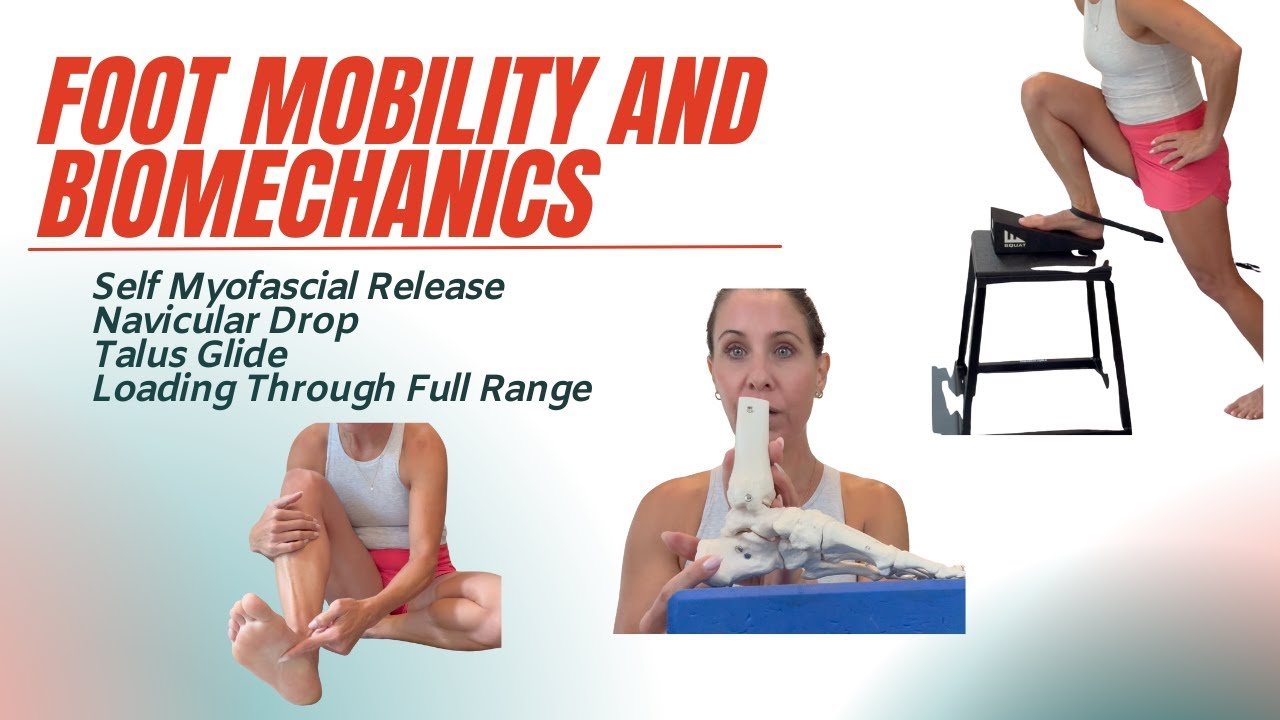
There are many ways to improve foot mobility, but it is key to look beyond the foot at the rest of the lower limb and what is happening above in the kinetic chain.
Why the foot gets stiff
If your posture is more extended, or your pelvis sits more forward, your center of mass shifts toward the middle and front of the foot. When that happens there is more tension in the calf, you tend to grip with your toes, and the midfoot stays more rigid.
A rigid arch doesn't necessarily mean your heel is rolling to the outside. I have worked with many people whose heel is everted while the midfoot works hard to stabilize and stays rigid. If we lack stability or mobility in one area of the body, we will find it somewhere else. In this case, the foot.
The talus and dorsiflexion
When you move into dorsiflexion, the talus has to roll anteriorly and glide posteriorly. If your center of mass is forward and the talus is forward too, getting that posterior glide is hard. You may feel a jammed sensation at the front of the ankle, and it can limit dorsiflexion, squatting to deeper ranges and release of the midfoot.
Even if your midfoot is flatter, you can still use these exercises. The goal is to strengthen the arch through its full range, both as it descends (eccentric loading) and as it lifts (concentric loading).
4 steps to explore
1. Release. Use a ball to roll the midfoot, moving side to side under the arch and slowly working back toward the heel. Then work along the inside of the foot, under the ankle bone, and up the back of the calf into the outer part of the tibia, where the posterior tibialis lives. Spend a couple of minutes on each side, using as much pressure as feels comfortable.
2. Drop the navicular. With your heel up, thrust into the front of the foot, as if punching your big toe mound into the floor. This helps drop the arch and navicular bone for a quick release. Do 10 to 15 reps.
3. Talus glide. Hook a band low to the floor and loop it around the ankle, just below the inside ankle bone, so it pulls down and back. Step onto a step (a wedge helps), find the inside of your heel, and let yourself move forward into dorsiflexion while staying heavy in the heel. Do 10 to 15 reps per side.
4. Load the full range. Drop the knee into dorsiflexion, turn slightly away from the standing leg, then rise onto the foot with the knee locked, turning toward the leg. Lower slowly with the knee bending and rotate away to stretch through the arch. Do 8 to 10 reps.
Make it last
To keep improving foot mobility, integrate the entire kinetic chain and layer in strength exercises that create a full body connection. That is where the lasting change happens.
Watch more

Flat Feet? Navicular Drop Explained + Foot Pronation Exercises

Lower Limb Series Part 1: Lower Limb Mobility

Pelvic Floor and Foot Connection: A Missing Link in Pelvic Floor Tension
Keep exploring
Expand your toolbox in my 12-week Empowered Performance mentorship, start with my free 5 Day Fundamentals, or move with me in weekly Alchemy classes.
