Full Body Approach to Reduce Neck Tension
Oct 17, 2026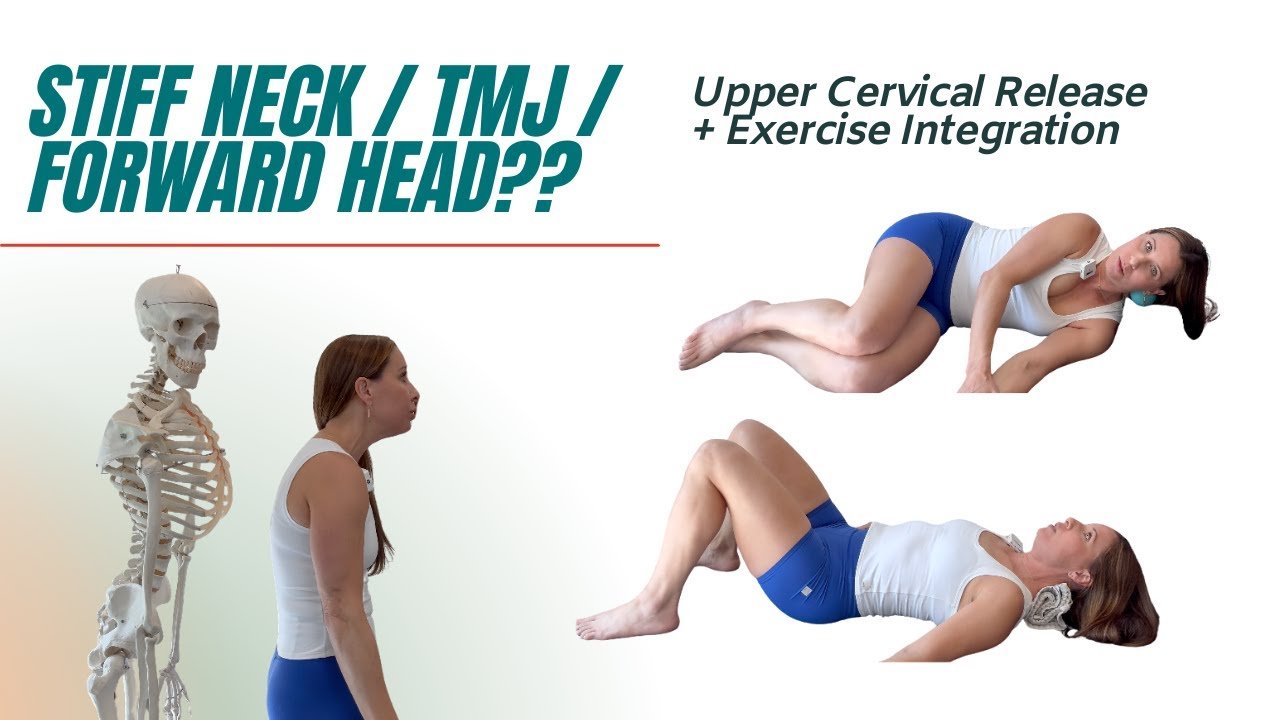
Reducing tension in the upper cervical spine can make a big impact on the rest of the body. If the upper neck can't do its job, the body finds other strategies to get the job done, and over time those strategies can build up too much tension. Here is how I look at the neck from the whole body, how to test yourself, and the drills I use.
Test your neck first
You may feel more restriction on one side than the other, which is useful information.
- Lower cervical rotation: turn your head to the right and the left and notice which side feels more restricted.
- Upper cervical rotation: tuck your chin all the way down to your chest, hold it there and rotate left and right. Compare the two sides.
- Side bending: keep your head neutral and side bend to the right, then to the left, noticing any restriction.
Why the chest wall matters
We should have some lordosis, or curve, in the cervical spine. When the chest wall compresses, the head moves forward and we lose that curve in the lower cervical spine. To counter it, the upper cervical spine goes into extension, and if we want rotation we need the lower cervical spine to give it to us.
That is why this isn't only a neck problem. We need the chest wall to lift so the head can rest optimally over the thorax, and we need to improve the rib cage and expand through the chest. If I only elevate my line of sight, my natural tendency is to drop back down, so we need to reduce tension in the upper cervical spine and then use the arms and head to help.
Four drills to explore
Use a pressure that feels comfortable. You'll need a small therapy ball (a hard ball), a yoga block and a towel roll.
1. Ball for the upper cervical spine, with side bending. Place the ball on the side of the upper neck, just behind the ear, resting on a yoga block. Sit in neutral for a second. As you inhale through your nose, side bend slightly away, then relax and sink over the ball as you exhale. Do five or six breaths, then move the ball slightly back and repeat. Do about five or six breaths in each position.
2. Towel roll under the lower neck with a ball in the upper back. Place a good-sized towel roll behind your lower cervical spine. Depending on how much compression you have in the front of your body, you may need a larger towel or several towels so you feel supported and can relax. Then place the ball in the upper back, just above that. Hold the position, let your pelvis tilt forward slightly, and inhale into the chest wall. Exhale and come back, and you'll see your chin tilt up a little. Repeat for about 10 breaths.
3. Reaches to rotate side to side. From the same setup, add a small tip forward of the pelvis (not a big anterior tilt) and reach one arm forward so the shoulder protracts and pushes the ball over. Inhale, tilt forward and reach, then exhale and come back. Repeat for about five breaths, then reset with the other arm. You can also alternate reaches, reaching with one arm and then the other as the pelvis rocks forward and back.
4. Wall sit with the towel roll. Set up in a short seated position all the way up against the wall, with the towel roll under your lower cervical spine and the back of your skull. Imagine your chin tucking slightly back. Reach one arm forward, press the same side of the back of your skull into the wall a little harder, and let that side of the chin come back. Inhale, exhale, then switch sides. Do 10 breaths, five on each side.
How to integrate it into training
In any exercise where you can add a reach, keep your head facing forward so you aren't reaching and rotating the cervical spine with it. You get relative motion between the thorax and the head. For example, in a lateral lunge you can reach with one arm while the head stays neutral, which gives you a counter rotation back at the neck. You can do the same in a reverse lunge, alternating sides, or in other full body exercises like pressing and overreaching. You can do this on pretty much any exercise.
Watch more

How to stretch your diaphragm for better 360° breathing

Breathing in Extension, Not Just Flexion | Diaphragm & Rib Cage Mechanics
Keep exploring
Try my free Spinal Health in Motion course, move with me in weekly Alchemy classes, or learn the full approach in Empowered Performance.
