
How to Stretch Your Diaphragm for Better 360° Breathing
Oct 17, 2026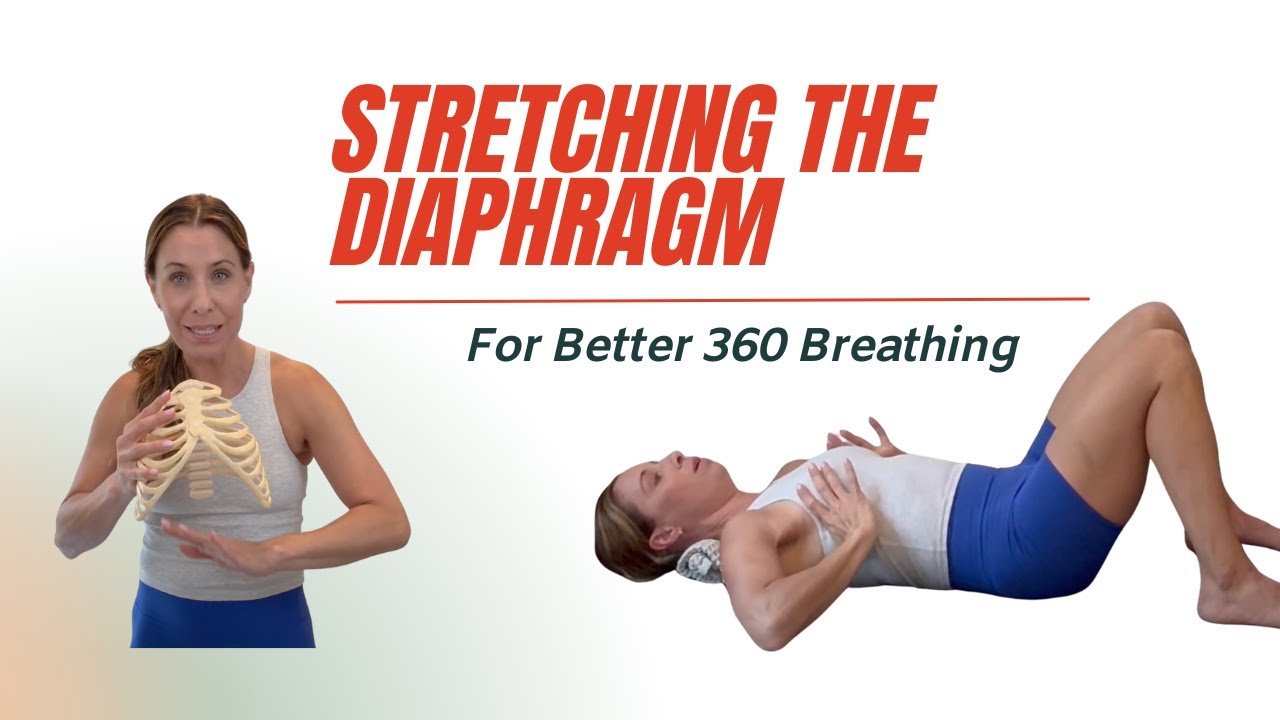
"Stretching the diaphragm" is a term you won't find in many textbooks, but I use it to describe something very practical: allowing the diaphragm to spend time in a lengthened, descended position so it can recoil back up into a nice ascended position. Here is who needs it, why it matters, and three drills to try.
Who needs to stretch the diaphragm?
If someone has a significant rib flare, where the ribs have shifted forward into an extended position, the diaphragm tends to live in a more inhaled, descended state. Many people are living in that state: more inhaled, breathing more often, and pushing down on the diaphragm with every breath.
The usual advice is "get a really good exhale and bring the diaphragm into its dome position." The problem is that the rib cage position often makes that very hard. A narrow, compressed rib cage with a flare makes it difficult for the diaphragm to come up and for the pelvic floor to lift, and like any other muscle in the body, the diaphragm sometimes needs to lengthen before it can recoil.
Why the exhale can go the wrong way
When the diaphragm is stuck in a more inhaled position, you can get a paradoxical breathing pattern. Instead of the ribs coming down and the diaphragm doming up, the exhale pushes pressure down and forward, the belly protrudes, and the upper abs and neck can end up compressing to make the exhale happen. That is the pattern we want to reverse.
That is why I often accentuate the inhale first. Improving rib cage space and giving the diaphragm a reflexive stretch sets up a much better exhale. I have used this with multiple clients and in multiple case studies in my Academy.
Three drills to explore
1. Slow inhale, hold, passive exhale. Lie on the ground and place your hands on your lower ribs. A towel under your neck can help if you tend to pull with your neck muscles. Take a slow, long inhale through your nose without using your neck, and when you get to the top, hold your breath. Hold for as long as is comfortable for you (in the video it can be up to around 45 seconds) until you get that first real urge to exhale. Then let your body exhale naturally. Don't try to compress your ribs or use your abdominals. Do about three to four breaths like this. If you get lightheaded or uncomfortable, shorten the hold.
2. Expand the upper ribs with feedback. Place your hands on your rib cage just under your armpits. If you can't reach, loop a super band around that area for feedback. Imagine the top of your rib cage getting wider at the sides and wider front to back as you inhale. Then stay big up top as you exhale from the bottom, and don't let the upper part of the rib cage collapse. Watch that the bottom portion is what closes down.
3. Bottom-up contraction, then inhale in 360°. Once you have that bottom-up contraction, think of the ribs coming down and in so you have a corset of deep abdominal tension. Hold that tension and inhale into the pelvic floor, the chest and the upper lateral ribs. There won't be much movement from the lower ribs. The goal is to keep the tension from the bottom up, like a corset, while you inhale everywhere else. This helps reshape the rib cage so the diaphragm has a bigger space to dome up into. Reaching forward can help push the thorax out of a big extended posture. I'd do about 15 to 20 breaths, then re-evaluate your posture. I think you'll be surprised at what this shows you.
Watch more

Breathing in Extension, Not Just Flexion | Diaphragm & Rib Cage Mechanics

Breathing Strategies for Different Body Types
Keep exploring
Learn more about breathing mechanics in my free Pelvic Floor in Motion mini course, try my free 5 Day Fundamentals, or go deep in Empowered Performance.
