Lower Limb Series Part 2: Lower Limb Strength for the Foot, Ankle and Knee
Oct 17, 2026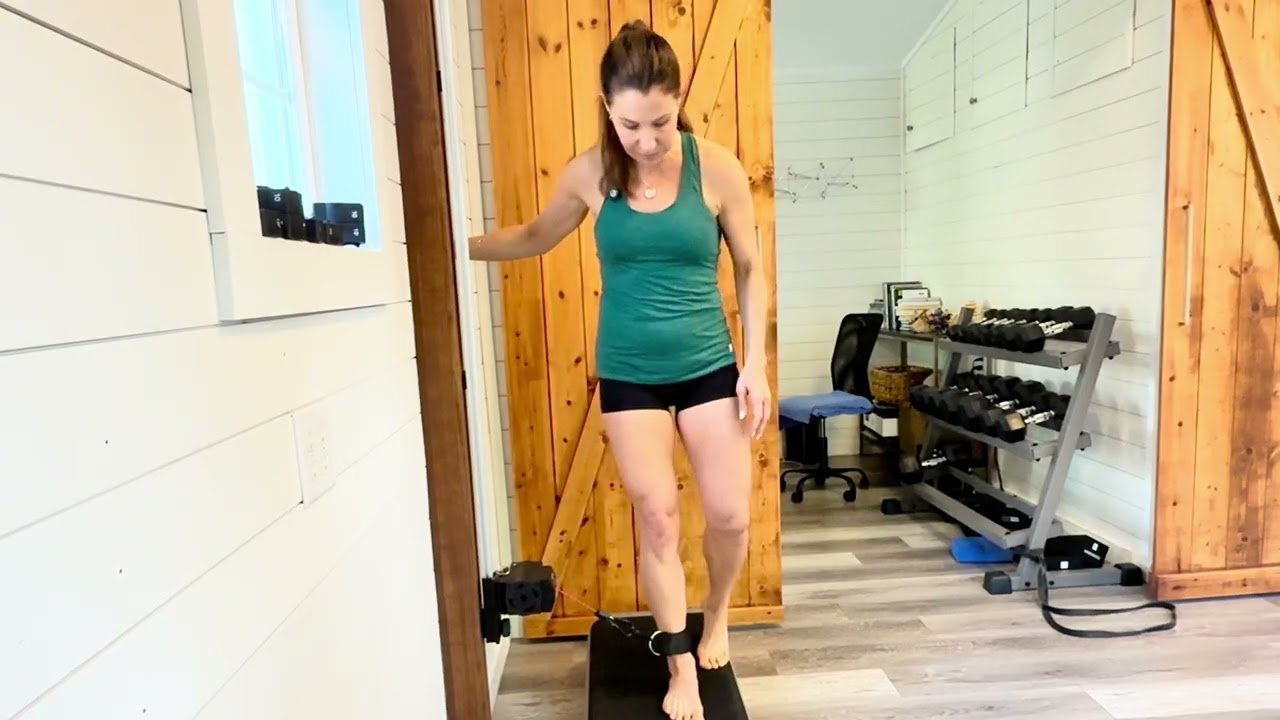
After building mobility in Part 1, this video covers strategies to build stability and strength around the foot, ankle and knee. One of the biggest things I see with the foot is a lack of progressive loading in both shapes, supination and pronation. Beyond our general compound lifts, we rarely truly add load to the foot in an inverted or everted position.
Start with a quick self-assessment
Take a photo of yourself from the front and back and look at your calcaneus, your heel bone. For many people one heel is more everted (tipping in) and the other more inverted. Depending on the differences between the two sides, you'll use one of two strategies. For example, if I'm more everted on the left and more inverted on the right, I work on inverting the left heel and everting the right, gaining strength in both a pronated and a supinated shape of the foot.
Strategy 1: a band
With a medium super band, pull out against the band so it pulls your heel into inversion, then resist that pull by forcing yourself into the medial portion of the heel. I do this on my right foot because my right heel is more inverted and I struggle to find the inside of the heel. It loads the outside calf, the peroneals, to help you rock into the inside heel.
To support the transverse arch you have two options. Wedges placed under the outside fourth and fifth metatarsals and the first metatarsal give support. If you have a stiff, rigid foot, be careful: elevating the metatarsal head engages the windlass mechanism and can flatten the arch a bit. The goal is good contact at the first metatarsal head and fifth metatarsal head so you're ready to load into the foot.
For a foot that tends to evert and fall to the inside of the heel (my left), place the band around the outside so it pulls you into more inversion. Check that you aren't losing the first metatarsal head when you find the outside of the heel; if you are, a wedge under it helps, and now the arch lifts.
Strategy 2: a cable and an ankle strap
If you have a cable and an ankle strap, you can add a fair amount of load. I've gone up to 50 pounds, but you can start at 10 to 15 and work up. As with the bands, my right foot wants to be in more inversion, so I have the cable pull me that way and resist into more eversion. For the other foot, I pull out into inversion with the strap around my ankle, finding the outside of the heel. You can add wedges for extra support so you can shift to the outside without losing the first metatarsal head.
The sequence for the more inverted foot
Start with the band pulling you into inversion and counter it, keeping your first metatarsal head and your fourth and fifth metatarsals down. Slightly soften the knee and find the inside of the heel, with your weight over to that foot. You might feel sensation in the foot and the outside of the calf. Keep the toes relaxed, and use something to rest on if you need balance.
- Hold for 30 to 60 seconds.
- Knee bends: bend the knee forward and straighten, trying to stay on the inside of the heel. Straightening tends to turn the tibia out and make the inside heel harder to find. Do 10 to 15 reps.
- Hinge: soften the knee, get into a hinge position, keep the knee over the middle of the foot and stay on the inner heel with relaxed toes. You can hike and unhike the hips, and may feel the hamstrings. From there, rotate away from the foot and then toward the leg while keeping pressure down.
- Isometric split squat: go down, let the foot rock from the outside heel to the inside heel, and push into eversion against the band to create more tension through the ankle and lower limb.
The sequence for the more everted foot
On my left foot I'm trying to create more inversion and find the outside of the heel, so I set my wedges and start in a kickstand position. The arch lifts, and the wedge supports the first metatarsal head. Relax the toes and ground the foot, holding for 30 to 60 seconds. You might feel quad and hamstring sensation.
- Knee bends: on this side, bending the knee forward helps internal rotation, so staying heavy on the outside of the heel is harder. That's useful for people whose knees cave in, and it strengthens the muscles that stabilize and rotate the knee. Do 10 to 15.
- Hinge: shift your weight over the midfoot, stay heavy on the outside heel, and use the hip to rotate toward that side. Hike and unhike the hips, then hold. You'll likely feel tension in the front of the shin and the back of the lower leg, possibly the flexor hallucis longus, which helps with the big toe.
- Split squat: rock between the inside and outside of the heel while actively pulling the heel out into inversion. There's lots of tension from the shin to the knee, and the glute is working.
Programming it
It depends on how your body (or your client's body) responds. If you're working with a pretty big twist in the lower limb and a lot of loss of position, you may want to do it more often, every other day, for two to three sets. Others might do it twice a week, or just once or twice as a warm-up to get the lower limb moving before big lifts, so squats and similar lifts feel much more supportive.
Watch more

Lower Limb Series Part 1: Lower Limb Mobility

Hack for more glute activation?!
Keep exploring
Try my free Spinal Health in Motion course, move with me in weekly Alchemy classes, or learn the full approach in Empowered Performance.
