
Still Leaking After Kegels? What Your Pelvic Floor Might Need Instead
Nov 11, 2026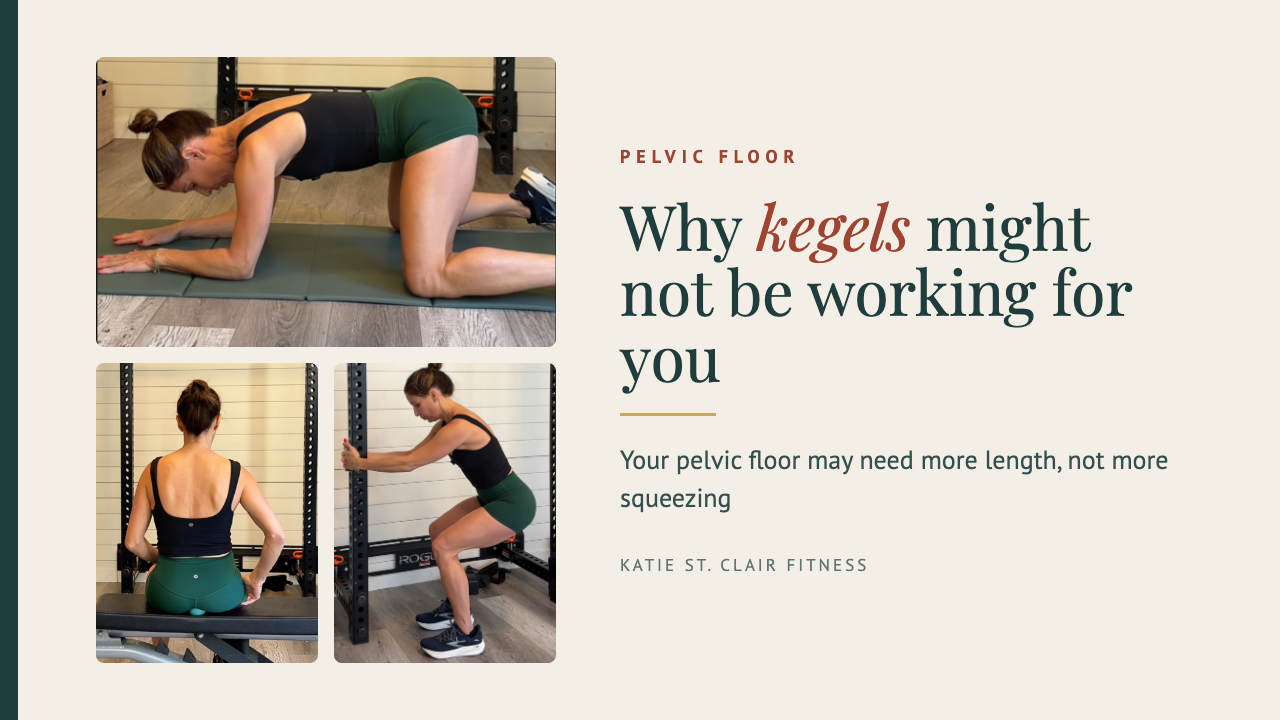
If you've been doing kegels and you're still leaking when you exercise, jump or sneeze, your pelvic floor may not need more squeezing. It may need more length.
That might sound backwards, especially if you've been told your pelvic floor is weak. But a pelvic floor that is holding tension all the time often has very little left to give when pressure suddenly increases. If kegels are working well for you, keep doing them. If they're not, there may be another layer to explore.
In this post, I'll walk you through why the pelvic floor works differently from your other muscles, how to release tension in each of its four quadrants, and what to try instead of kegels, using breath and position. There's a short video for each part so you can follow along.
Your pelvic floor isn't trained like your biceps
Imagine I told you to do 100 bicep curls several times a day. Then, once your biceps were exhausted, someone tossed a heavy medicine ball straight at you and you had to catch it. Your arms wouldn't have much left to give.
Your pelvic floor works in a similar way. Its primary role is respiration. It works alongside your thoracic diaphragm, moving pressure up and down every time you breathe. Like any muscle, it needs to be able to lengthen and contract, and if it never gets to lengthen, it can't do that job well. Then, when you sneeze, jump or lift something heavy, it may not be able to respond to the change in pressure.
It can help to picture the pelvic floor as four quadrants: front left, front right, back left and back right. Each one needs to be able to lengthen fully. When one or more quadrants hold tension, pressure shifts onto the organs that sit above the pelvic floor, like the bladder, uterus and rectum. Taking that pressure off gives those organs a more optimal position to function from.
If you'd like to go deeper into why kegels aren't the whole story, my post No More Kegels: 5 Things That Improve Pelvic Floor Performance Without the Pelvic Floor is a great place to start.
Part 1: Release tension in all four quadrants
The first step is noticing whether you can feel pressure move into each quadrant as you breathe. You'll do this with light external pressure from your fingers.
The front of the pelvic floor
- Bring one foot up so you're in a lot of hip flexion. This position lets pressure travel down and forward.
- Place your fingers just behind the vaginal opening on the left side.
- Take an inhale and imagine sending pressure down into your fingers.
- Take three or four breaths, then switch to the right side and repeat.
The back of the pelvic floor
- Sit up tall so your sit bones are wide.
- Place your fingers between your sacrum and your sit bone on one side.
- Take a big inhale and see if you can feel the pressure coming down and back into your fingers.
- Repeat on the other side.
If a quadrant is hard to feel
If you struggle to feel pressure push down into any of the four quadrants, grab a therapy ball or a tennis ball.
- For the front: place the ball in the same spot you palpated and sit on it, letting your body relax over the ball for a couple of minutes.
- For the back: place the ball between your sit bone and your sacrum and have a seat. You can move your thigh and glutes out of the way so the ball sits right where you need it. Stay there for two or three minutes.
Afterward, retest each quadrant with your breath and notice what feels different.
Part 2: What to do instead of kegels
Once you've released some tension, the next step is helping your pelvic floor lengthen and contract with your breath. The position of your pelvis makes a big difference here.
When you're in roughly 60 to 120 degrees of hip flexion with your pelvis in a more neutral position, the back of the pelvic floor lengthens, so pressure can travel back when you inhale and not just down and forward. When you drop low into a deep squat, the pelvis moves into more external rotation and posterior tilt, which lengthens the front of the pelvic floor, so pressure travels more forward and down.
This is what makes these exercises different from a few random core moves. You're training your body to create different shapes in the pelvis, so the pelvic floor can work through its full range.
Wide-knee breathing
- Set up on your hands and knees with your knees about the width of your mat, then lower down to your elbows.
- Untuck your pelvis slightly so you have a gentle curve in your low back. This opens the space between your sit bones.
- Actively push your knees outward as you inhale, and think about breathing down into your pelvic floor. You should feel some expansion in the back of the pelvic floor.
- Once you've reached that full length, exhale and think about lifting your guts up off the pelvic floor with your diaphragm as the pelvic floor contracts and rises.
- As you exhale, actively pull your knees together. This turns on your adductors and gives you a stronger contraction.
Assisted squats
Hold on to something sturdy for support.
- At the bottom: sink all the way into the bottom of a squat. Inhale and send pressure down, which travels more into the front of your pelvic floor.
- Halfway up: come up to about halfway, keeping your sit bones wide and your pelvis tilted slightly forward. Inhale here, and the pressure travels more into the back of your pelvic floor.
- Exhale as you lower back down, then repeat, inhaling at the bottom and exhaling as you come up.
These principles carry over into real life and into your training. Every time you squat, hinge, lift or jump, you're working with the same relationship between breath, position and pressure.
Bringing it into your training
You don't have to practice this separately from your strength training. Breath, position and pressure are part of how your body organizes movement in the first place, so you can keep exploring them every time you train.
As you try the release and the exercises, notice which quadrant is hardest to breathe into and which position feels least familiar. That's your body showing you where there's a little more room to find. And if you're dealing with ongoing symptoms or pain, a pelvic floor PT can be a wonderful partner alongside this work.
The pelvic floor is also connected to everything above and below it. If you'd like to keep pulling those threads together, these posts are a good next read:
- 10 Tips for an Athletic Pelvic Floor
- Foot and Pelvic Floor Connection: How Your Feet Affect Pelvic Floor Symptoms
Questions about any of this? Email us at [email protected].
Keep exploring
Start with my free Pelvic Floor in Motion mini course, move with me in weekly Alchemy Strength classes, or learn the full approach in Empowered Performance.
